
Why Friendship Breakups Hit So Hard
Written By: Amber Robinson
You've been scrolling past their name for weeks. Maybe you see a song they'd love, a restaurant you know they'd hate, a dumb meme made for them specifically — and there's nowhere to send it. That's what a friendship breakup feels like. A thousand tiny losses, all at once.
IN THIS ARTICLEWhy friendship loss doesn't get the grief it deservesThe psychology behind the painWhy it can hurt more than a romantic breakupWhat the research actually saysHow to find your road through
Whether you're wondering why you feel hollowed out after a falling-out with someone you've known since college, or you're quietly unfollowing a group chat you used to live in — friendship grief is real, it's widespread, and it's dramatically underacknowledged.
We have rituals for romantic breakups. We have language for them, playlists, a cultural script. But when a friendship ends? Most of us are handed silence and expected to get on with it.
Let's change that. Here's what psychology actually says about why losing a friend can knock the floor out from under you — and why that pain is a sign of something meaningful, not something to be ashamed of.
First: why doesn't friendship grief get taken seriously?
There's a concept in grief psychology called disenfranchised grief — coined by researcher Kenneth Doka in the 1980s. It describes grief that isn't socially recognized or validated. Society doesn't give you a script, a week off work, or a casserole on your doorstep when a friendship ends.
Friendships are seen as voluntary, fluid, less "official" than romantic or family bonds. So when one dissolves — whether through a dramatic falling-out or a slow, painful fade — there's no established way to mourn it. That lack of recognition makes the pain harder to process, not easier.
Disenfranchised grief is grief that goes unacknowledged by the people and structures around you. Friendship loss is one of the most common examples — and one of the least talked about.
The result? You feel the loss just as acutely as any other, but you also feel a low-grade shame about feeling it at all. Which doubles the weight.
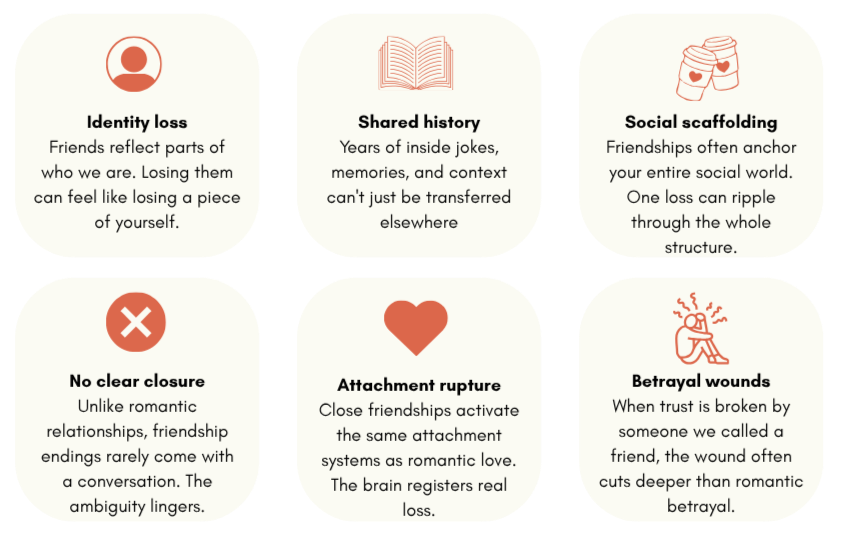
Your brain genuinely experiences it as loss
Neuroscience backs this up. Close friendships activate the brain's social reward and bonding circuits — the same systems involved in romantic attachment. Research using fMRI imaging shows that social pain (like rejection or exclusion) activates the same regions as physical pain: specifically, the dorsal anterior cingulate cortex and the anterior insula.
In other words: when you lose a close friend, your brain isn't being "dramatic." It's processing something that genuinely registers as painful on a neurological level. Feeling devastated isn't weakness. It's wiring.
Why it can sometimes hurt more than a romantic breakup
It sounds counterintuitive, but friendship breakups can land harder — for a few important reasons.
You didn't expect it to end
Romantic relationships come with an implicit awareness that they might not last. But friendships? We expect those to be for life. The shock of losing a "forever friend" can be completely disorienting in a way romantic loss isn't.
There's no social permission to grieve
After a breakup, your friends rally. You get the group chat, the wine, the I knew they were wrong for you. After a friendship ends? You might not even have the same support network left — especially if the lost friend was part of your wider social circle.
The loss is often ambiguous
Many friendship breakups aren't dramatic. They're a slow fade — unanswered texts, cancelled plans, a conversation that never quite bounces back. Ambiguous loss (a term coined by therapist Pauline Boss) is often harder to grieve because there's no clear moment of ending. You keep half-hoping, which keeps the wound open.
"Ambiguous loss" — grief without closure — is one of the most psychologically difficult experiences to process. A slow-fading friendship is a textbook example. The lack of a clear ending makes it almost impossible to know when or how to begin healing.
Your sense of self can take a hit
Psychologist William Swann's research on self-verification theory shows that we rely on close relationships to confirm who we are. Friends mirror us back to ourselves. When you lose a long-term friend, you can lose access to a version of yourself — the person you were with them, the parts of you they knew, the growth you shared. That's a grief all of its own.
If you're in California: you're not alone
Across Southern California — from Los Angeles to the Inland Empire — and up through the Bay Area, therapists are reporting a surge in people seeking support for what they're calling "friendship grief." The post-pandemic reshuffling of social lives, relocation for housing costs, and the particular loneliness of sprawling, car-dependent cities all conspire to make meaningful friendship harder to maintain — and its loss harder to bear.
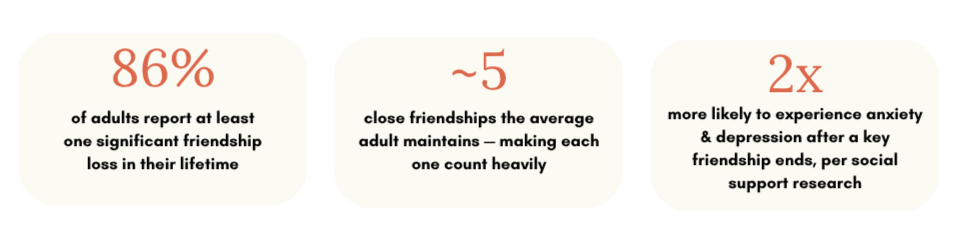
The Surgeon General's 2023 Advisory on Loneliness flagged that Americans report fewer close friends than ever before, with young adults hit hardest. California's therapy culture, thankfully, is one of the most open in the country to treating this kind of grief as the genuine mental health issue it is.
If you're working through a friendship loss, you don't have to reframe it as "not a big deal." It is a big deal. And support is available.
How to find your road through
Healing from a friendship breakup isn't linear, and there's no single script. But there are things that genuinely help:
Name it as grief
Start by giving it the weight it deserves. Tell yourself — and someone you trust — that you're grieving a friendship. The moment you validate your own pain, it becomes easier to process.
Resist the urge to rewrite history
It's tempting to either villainize the person or tell yourself the friendship never mattered. Both are self-protective distortions. Holding the complexity — it was real, and it's over — is harder but healthier.
Don't rush the timeline
Grief doesn't follow a schedule. Some friendship losses take years to fully process, especially if the friend was deeply woven into your daily life or sense of identity. Give yourself the same grace you'd give someone going through any other significant loss.
Consider talking to someone
A therapist — especially one familiar with grief and relational trauma — can help you make sense of what happened without getting stuck in loops.
Rebuild slowly and intentionally
When you're ready, building new social connections doesn't mean replacing what was lost. It means investing in different, evolving chapters of yourself. Community classes, grief support groups, local meetups — these are all legitimate starting points, not consolation prizes.
Here's what matters most: the pain you feel when a friendship ends is proportional to how much it meant. That's not weakness. That's love. And love deserves to be grieved properly — not minimized, not rushed, and not faced alone.
A Road Through exists for exactly this moment. Because healing from something real takes more than time — it takes a path.
You don't have to navigate this alone
Whether you're processing a friendship loss or something else entirely, our therapists specialize in helping you find your way through — at a pace that's right for you.
